


Canada’s AI Future: From Policy to Practice — Insights from the conversation with The Honourable Evan Solomon

Platform Calgary serves as the front door to Calgary’s innovation ecosystem. Connecting entrepreneurs with capital, talent, and mentorship, Platform brings together 180+ partners to help tech companies start, commercialize, and scale faster. Together, we are building a thriving tech ecosystem to strengthen Calgary’s global economy.
More about Platform CalgaryOn March 18, 2026, Platform Calgary welcomed The Honourable Evan Solomon, Minister of Artificial Intelligence and Digital Innovation, to the Platform Innovation Centre for a timely conversation on Canada’s AI future.
Powered by our sponsors eStruxture, the event brought together founders, investors, policymakers, and ecosystem leaders, the visit created space for both public dialogue and candid, off-stage discussion about what it will take for Canada to compete in an AI-driven economy. The day began with a roundtable discussion featuring local founders and industry leaders, followed by a public program on the KPMG Pitch Stage.
Together, those conversations pointed to a central question: how can Canada turn world-class AI research and ambition into globally competitive companies, while keeping talent, capital, and intellectual property anchored at home?
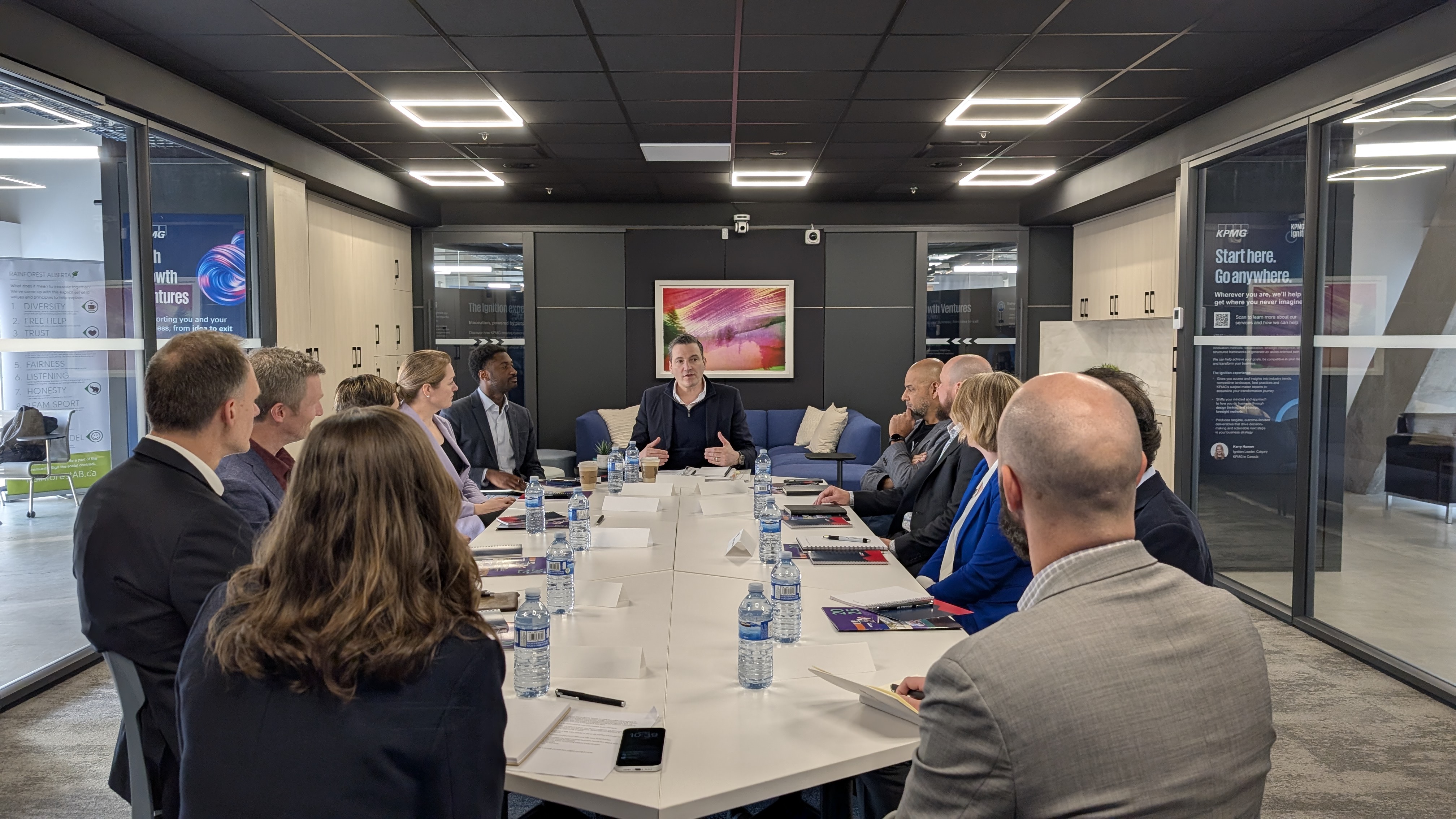
What we heard in the Founder x AI roundtable
Prior to the public program, Platform Calgary convened a roundtable discussion with founders and ecosystem leaders to ground the national conversation in real, on-the-ground experience.
The discussion brought together leaders from across Calgary’s innovation ecosystem, including representatives from Blackline Safety, Ava Industries, Ambyint, Arcurve, Hexagon, Aimsio, Headversity, and WaitWell, alongside Platform Calgary.
Scaling the Canadian AI Ecosystem: Key Challenges and Opportunities
While the conversation spanned sectors and perspectives, two clear themes emerged.
1. Solving the Growth-Stage Capital Gap
The primary hurdle for Canadian AI companies remains the ongoing structural gap in growth-stage capital, which continues to drive early exits and acquisition of promising Canadian companies. There was strong alignment on the need for a more coordinated national approach — one that supports not only research and early-stage innovation, but also the infrastructure and capital required to scale. This includes a more deliberate strategy around compute and data centre capacity, particularly for applied AI across industries like energy, mining, and manufacturing.
To keep Canadian innovation at home, the ecosystem requires:
- Coordinated National Support: Moving beyond research to support late-stage commercialization.
- Digital Infrastructure: A deliberate strategy for compute and data center capacity.
- Applied AI Focus: Prioritizing high-impact sectors like energy, mining, and manufacturing.
2. Transitioning from AI Experimentation to Adoption
The next frontier for Canadian tech is moving past the "pilot" phase into real-world, industry-wide integration. Currently, many leaders are tackling identical hurdles in isolation.
Across sectors, leaders are navigating similar challenges around workflow integration, trust, procurement, and human oversight — often in isolation. There was a shared view that Canada has an opportunity to accelerate adoption by enabling stronger cross-sector learning, and by ensuring the government plays a more active role not only as a policymaker, but as a customer and early adopter of Canadian-built solutions.
Barriers to AI Adoption Include:
- Workflow Integration: Harmonizing AI with existing legacy systems.
- Trust & Oversight: Establishing frameworks for human-in-the-loop governance.
- Procurement: Navigating complex buying cycles, particularly within the public sector.
3. The Government’s Evolving Role
While no single solution emerged, the roundtable reinforced a key idea:
Canada’s AI strategy will be strongest when it reflects the lived realities of the builders it aims to support. For Canada to lead, the federal government must shift its identity from being purely a policymaker to becoming a strategic customer. By acting as an early adopter of Canadian-built solutions, the government can provide the "social proof" and initial revenue needed for founders to scale globally.

A hinge moment for Canada’s innovation economy
During his keynote speech Minister Solomon described the present as a “hinge moment” defined by two forces unfolding at once: a global political realignment and an accelerating technological transformation. In his view, these changes present real risks to sovereignty, competitiveness, and trust — but also create significant opportunities for countries prepared to act with confidence and pragmatism.
That duality set the tone for the day. The challenge is not simply to be enthusiastic about AI or fearful of it, but to be open to the opportunity while candid about the concerns.
From “Team No” to “Team Yes”
One of the strongest themes from the Minister’s remarks was his contrast between what he called “Team No” and “Team Yes.” Team No is easy: it doubts, delays, and defaults to caution. Team Yes takes risks, builds despite uncertainty, and chooses action over inertia.
It was a message that landed in a room full of founders, investors, and ecosystem builders. Minister Solomon positioned entrepreneurs as the people most willing to take on the harder road — the people who back ideas before there is certainty, who navigate risk before there is consensus, and who keep going when systems around them say no.
In that framing, the government has a specific role to play: not to dictate innovation from the top down, but to help clear barriers and create conditions for builders to succeed. As he put it, the job is to help “Team Yes” move faster, with more support and less friction.
For Calgary, that message felt especially resonant. This is a city that has repeatedly reinvented itself through periods of change, and the current momentum in the tech sector reflects that same willingness to build through uncertainty.
What the AI Strategy is trying to solve
At the centre of the discussion was the federal government’s evolving approach to AI policy. Minister Solomon described a framework organized around three pillars: build, empower, protect.
The first pillar, build, is about creating the conditions for innovation to happen at scale. That includes access to capital, access to compute, access to customers, and the infrastructure required to support AI adoption and commercialization. The second pillar, empower, focuses on talent and skills — from post-secondary education to reskilling workers as technology changes the nature of work. The third pillar, protect, is about trust: protecting Canadian data, privacy, sovereignty, and the broader public confidence required for AI adoption to grow.
Underlying all of this is a simple but important principle: AI cannot be something that benefits the few. If Canada is going to lead, the benefits of AI need to be accessible across industries, regions, and communities.
The commercialization challenge remains a Canadian one
A key theme in both the roundtable and the public conversation was Canada’s long-standing commercialization gap. The country has produced exceptional research, strong technical talent, and globally respected institutions — yet too often, the companies and IP that emerge from that work are scaled elsewhere.
Minister Solomon addressed that issue directly, describing the familiar pattern of Canada planting and watering the seeds of innovation, only to see others harvest the results. Breaking that cycle, he argued, will require more than rhetoric. It will require targeted policy levers that help companies stay, scale, and compete from Canada.
That includes stronger access to capital across the company lifecycle, from seed to growth stage, as well as reforms to programs like SR&ED and expanded investment in compute. It also includes making sure founders can build companies here without feeling that the rational next step is to move IP, talent, or headquarters elsewhere.
For Calgary founders, this is not abstract. It speaks directly to one of the ecosystem’s most important priorities: ensuring that companies can start here, grow here, and remain rooted here while serving global markets.
Government as customer, not just funder
Another important thread in the conversation was the role the government can play on the demand side of innovation. Startups do not just need grants or incentives; they also need customers. And for many companies, a government contract can provide far more than revenue — it can provide validation, credibility, and momentum.
Minister Solomon acknowledged that procurement remains an area where change is needed. If Canada wants to accelerate adoption of homegrown AI solutions, the government has to become better at buying from Canadian innovators, not just talking about supporting them.
That matters for ecosystems like Calgary’s, where many companies are building practical, applied technologies that could create value across government, industry, and public services. A more effective procurement model would not only help startups scale, but also help demonstrate trust in Canadian-built solutions.
At the same time, the Minister was clear that a stronger Canadian innovation strategy does not mean retreating from international markets. In one of the more memorable lines of the day, he said that “sovereignty is not solitude.” Canada can strengthen domestic capability while remaining a trading nation and global partner.
Why the Canadian Ai Strategy matters for Calgary
Calgary has become one of the most dynamic tech ecosystems in North America, with growing talent density, stronger founder networks, and increasing national visibility. But growth alone is not the finish line. The next phase will depend on whether the ecosystem can convert momentum into long-term staying power.
That is why conversations like this matter. They help connect local experience with national strategy. They create visibility for the challenges founders are actually facing. And they reinforce Calgary’s role not just as a participant in Canada’s innovation story, but as one of the places helping shape where it goes next.
If there was one takeaway from the day, it was this: Canada’s AI future will not be built by policy alone. It will be built through the ongoing interaction between entrepreneurs, investors, institutions, infrastructure, and government — and through the willingness to move from “Team No” to “Team Yes.”
Watch the full conversation
Watch the full keynote and fireside discussion below:
Looking ahead
At Platform Calgary, we will continue to convene the conversations that connect policy to practice and bring together the people building the future of innovation in this country.
Because ultimately, Canada’s AI future will be shaped not just by what is announced — but by what gets built.
About Platform Calgary
Platform Calgary is the physical and cultural "front door" for innovators in Calgary, dedicated to ensuring tech companies can start, commercialize, and scale faster. As a keystone organization in the city’s tech ecosystem, Platform Calgary connects entrepreneurs to a city-wide network of partners and critical resources, including coaching and mentorship, talent, capital, and customers. Operating out of the 55,000-square-foot Platform Innovation Centre, the organization serves as a central hub where talent, ideas, and capital collide. Platform Calgary supports a diverse community of over 850+ member companies, ranging from early-stage startups to established scaleups, and works toward a single, ambitious goal: a 10x increase in the rate of startup creation and scaling in Calgary by 2031.

Published on
March 19, 2026
Tags
Explore more posts

For Ecosystem Builders
Beyond Headcount: How Companies Build Executive Teams That Last
Scaling effectively isn't about hiring faster or simply adding headcount; it requires treating leadership as a deliberate architecture that aligns executive talent directly with long-term business strategy.

For Ecosystem Builders
Calgary Climbs to 15th in North America: What CBRE's 2026 Scoring Tech Talent Report Tells Us About Our Ecosystem
CBRE has released its Scoring Tech Talent 2026: AI Realignment Underway report, and the data confirms what Calgary's tech community has felt building for a few years now: this city is one of the fastest-growing tech talent markets on the continent.



Land Acknowledgement
We honour and acknowledge Moh’kinsstis and the traditional Treaty 7 territory and oral practices of the Blackfoot confederacy: Siksika, Kainai, Piikani, as well as the Îyâxe Nakoda and Tsuut’ina nations. We acknowledge that this territory is home to the Métis Nation of Alberta, Region 3 within the historical Northwest Métis homeland. We respect all Nations who live, work, play, innovate and build things on this land, and in so doing honour and celebrate the territory.